
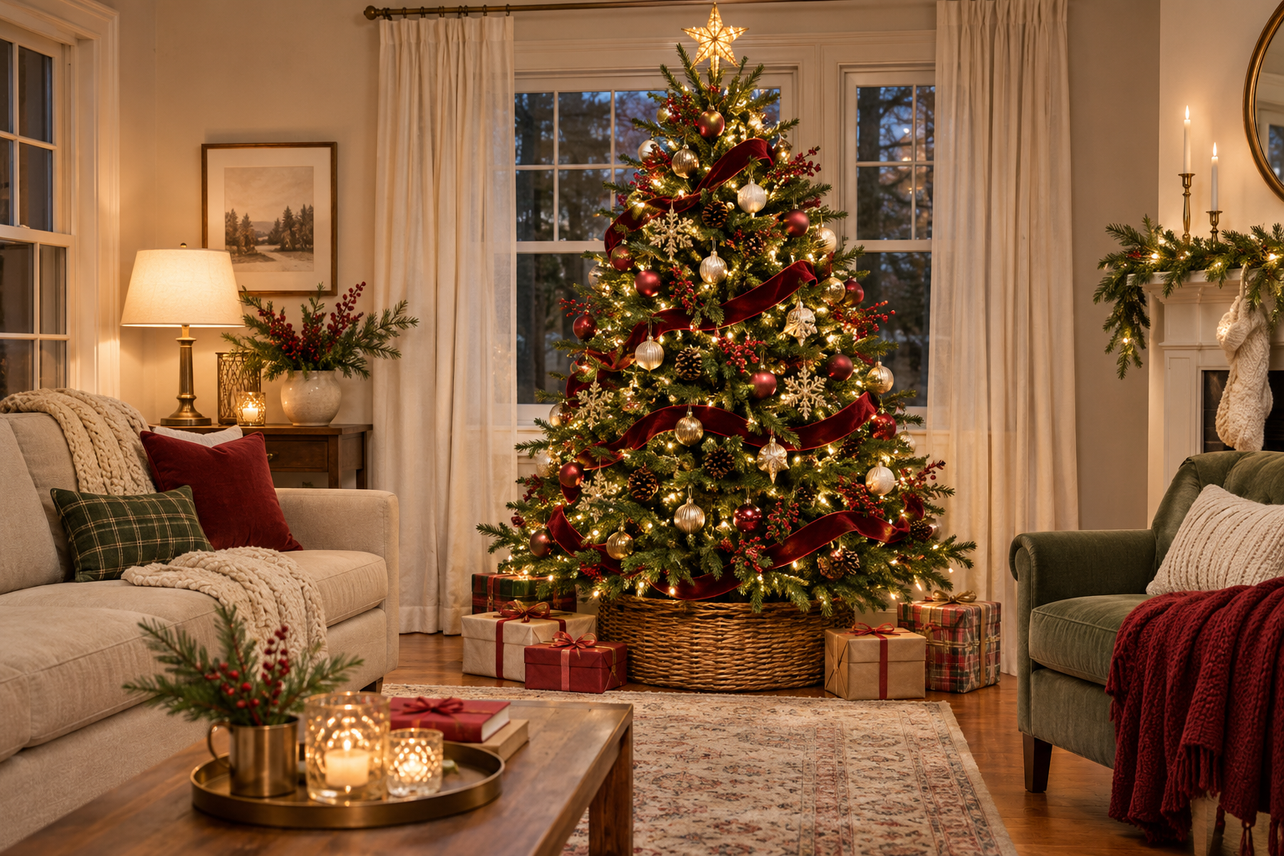
An artificial Christmas tree can be convenient, reusable and visually convincing, yet still feel disconnected from the rest of the room. The problem is rarely the tree alone. More often, it is the absence of a clear shape, balanced lighting, coordinated surroundings and a thoughtfully arranged base.
The solution is to treat the tree as part of the room rather than as a stand-alone decoration. Five layers make the biggest difference: placement and structure, surrounding greenery, light, ornaments and sensory details. Each layer should support the others without obstructing walkways, overwhelming a small room or creating avoidable safety risks.
1. Start With the Right Tree and Placement
Before choosing a tree, measure the available floor space as well as the ceiling height. Account for the stand, tree topper and the width of fully opened branches. A slim tree may suit an apartment or narrow living room better than a broad model, even when both have the same height.
Placement matters just as much as size. A tree should not block an exit or force people to squeeze around furniture. The National Fire Protection Association recommends keeping Christmas trees at least 3 feet from fireplaces, radiators, candles, heat vents and other heat sources. It also advises turning tree lights off before leaving home or going to bed. NFPA’s Christmas-tree safety guidance applies to the display as a whole, including artificial trees and added decorations.
Pre-lit trees can reduce setup time and produce more even light distribution, but they are not automatically the best choice for every household. Built-in lights can be harder to replace if a section fails, while an unlit tree gives the owner more control over color, spacing and future changes. Before using a pre-lit model, inspect its cords, plugs and controllers and check the model against the Consumer Product Safety Commission’s recall database.
Once the tree is assembled, open and separate each branch tip. Work from the bottom upward and step back periodically to identify visible gaps. Rotate branches where the construction permits instead of trying to hide every opening with ornaments. A well-shaped silhouette requires fewer decorations and creates a calmer finished result.
A skirt, collar or low basket can conceal the stand and visually connect the trunk to the floor. Choose one in proportion to the tree: an undersized skirt can look accidental, while an oversized collar may intrude into the room’s circulation space.
2. Connect the Tree to the Room
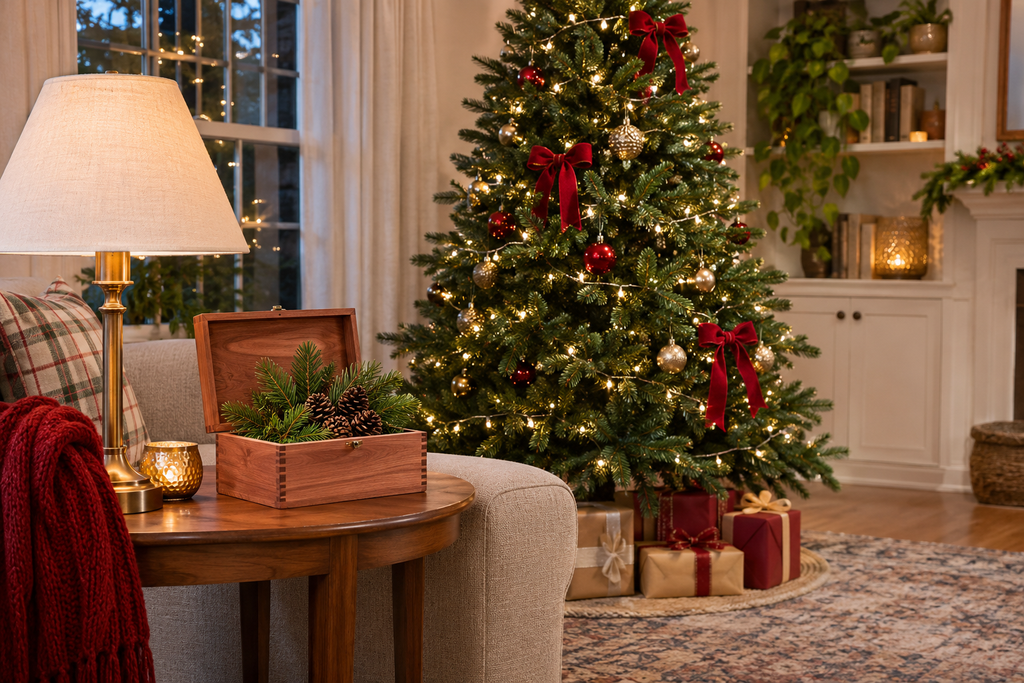
A tree often looks isolated when none of its colors or materials appear elsewhere. Repeating one or two elements nearby creates continuity without turning the entire room into a themed display.
For example, a short garland on a mantel, a restrained wreath or a few evergreen-colored textiles can echo the tree. Repetition is more effective than sheer quantity. If the tree contains burgundy ribbon and brass ornaments, using one of those colors elsewhere may be enough to make the arrangement feel deliberate.
Faux greenery is practical for households that want a consistent appearance throughout the season. Examine it in person when possible: varied needle shapes, irregular branch directions and a mix of matte tones generally appear more natural than uniformly glossy foliage. Bend wired stems gradually, and store them without crushing the tips so they can be reused.
Real greenery can introduce natural texture and scent, but it dries over time and must be kept away from flames and heat. It may also be unsuitable for homes with pets. The ASPCA advises that holly and mistletoe can cause illness when ingested and recommends keeping hazardous holiday plants out of animals’ reach or using faux alternatives. Its holiday pet-safety guidance also recommends securing the tree against tipping.
Avoid packing greenery around radiators, vents or electrical connections. The goal is to create a visual transition, not to hide equipment or impede airflow.
3. Build Light in Controlled Layers
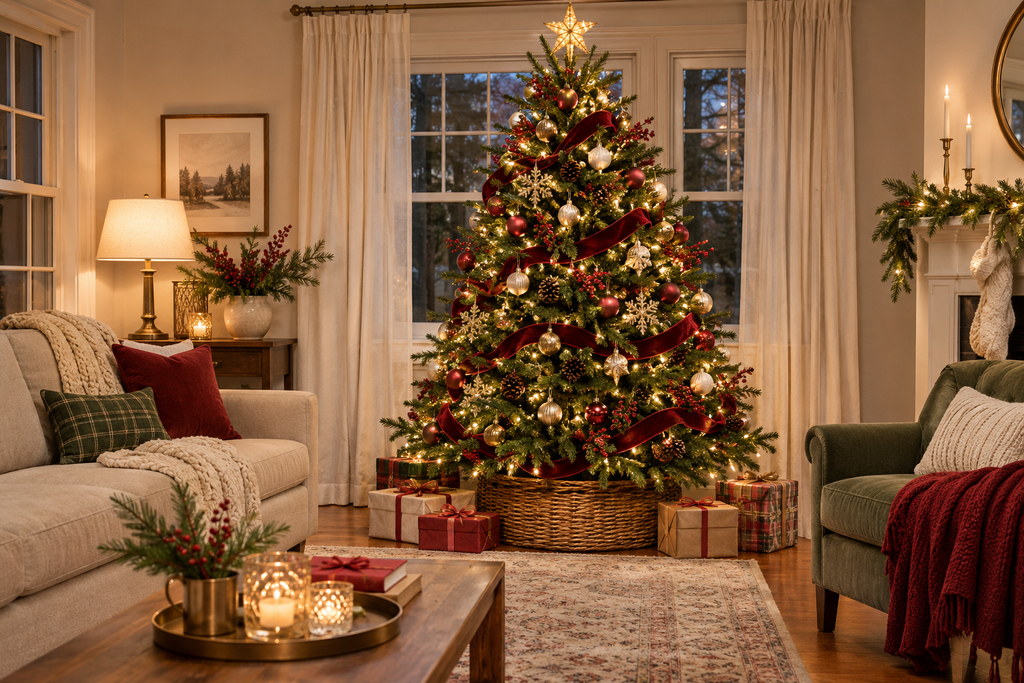
Lighting has a major effect on how the tree’s depth and color are perceived. Warm-white bulbs often create a softer, more traditional appearance, while clear cool-white bulbs can look crisper. Multicolor strands produce a playful or nostalgic effect. These are aesthetic choices rather than universal design rules.
If the tree is already pre-lit, consult its instructions before adding another strand. Do not assume that more lights can safely be connected through the tree’s existing wiring. The manufacturer should specify compatible replacement parts and the maximum number of connected sets.
The CPSC recommends using lights tested by a recognized safety laboratory, choosing products rated for their intended indoor or outdoor location, and discarding strands with frayed wires, broken sockets or loose connections. Its current holiday safety guidance also warns against overloading outlets.
When additional lights are permitted, begin near the trunk and work outward, distributing the strand across several depths. This creates dimension without concentrating every bulb on the branch tips. Keep plugs and control boxes accessible rather than burying them beneath fabric or greenery.
Never use lit candles on or near a tree. Flameless candles can provide a similar visual accent without an open flame, although their batteries and removable parts should still be kept away from young children and pets.
4. Arrange Ornaments With Rhythm and Restraint
A cohesive tree does not require every ornament to match. It needs repetition, spacing and a clear hierarchy.
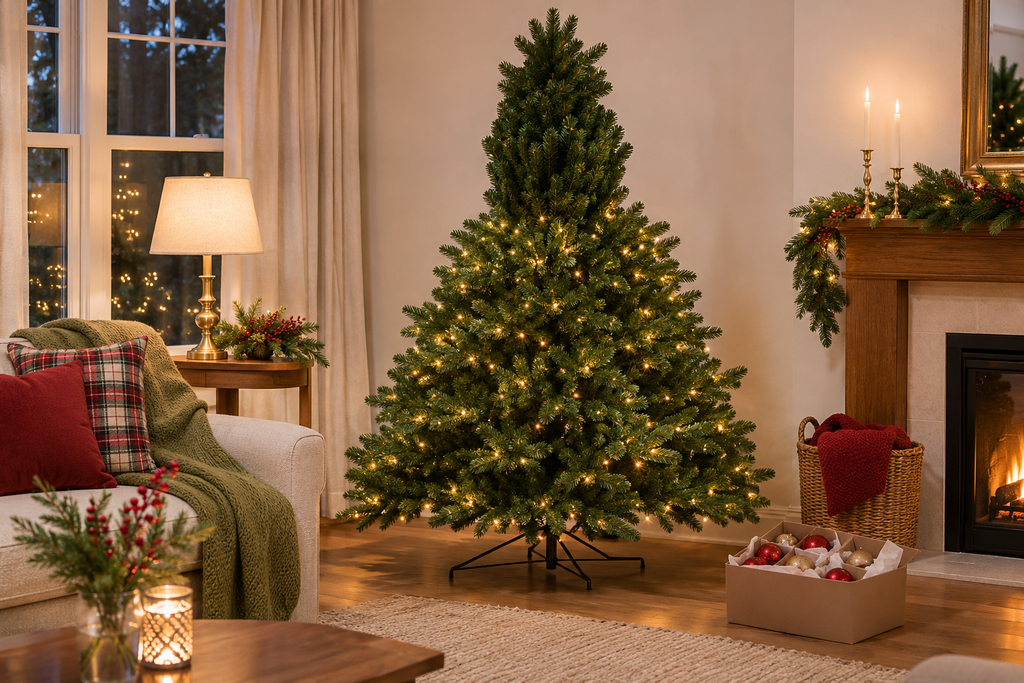
Begin with the largest ornaments, placing them on stronger branches and slightly farther inside the tree where they can fill visual gaps. Distribute medium ornaments across the main viewing area, then use smaller pieces on the outer tips. Fragile decorations belong higher up in homes with children or pets.
Choose two or three recurring elements to organize the display. These might include a color, material or shape, such as red glass, natural wood and gold stars. Personal ornaments can then be added as accents rather than forced into a rigid matching scheme.
Varying finishes also adds depth. Matte ornaments absorb light, glossy pieces reflect it and translucent glass allows light to pass through. Glass ornament production has a long association with Lauscha, Germany, a town known for its blown-glass decorations, as documented by the Victoria and Albert Museum.
Ribbon or garland can establish movement, but it should follow a consistent path. Vertical drops emphasize height, while a loose diagonal arrangement creates a more traditional wrapped appearance. Avoid pulling ribbon so tightly that it compresses the branches.
A topper should suit the tree’s scale and have adequate support. Stars and angels carry religious meaning for many Christian households, but there is no requirement to use either. A bow, botanical spray or simple cluster of ornaments can work equally well in a secular display.

5. Give the Base a Purpose
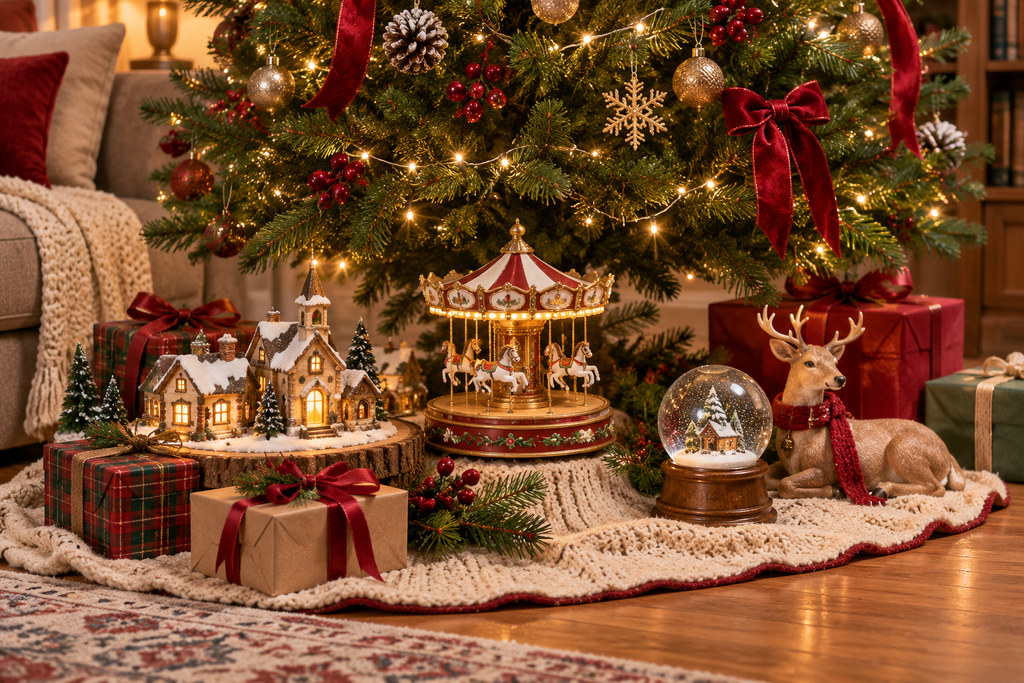
The area beneath the tree can complete the composition, but it should not become an obstacle course. A few wrapped boxes, a small village or a group of seasonal figures can create a scene without covering every inch of floor.
Use varying heights and leave open space between objects. Repeating colors from the tree helps the base read as part of the same arrangement. In a small room, one substantial object may look more intentional than numerous miniatures.
Animated decorations require additional planning. Stabilize moving figures, keep controls accessible and arrange cords so they do not cross walking paths. Do not place cords beneath rugs, and keep small parts, batteries and breakable ornaments away from children and pets. The display should also remain clear of exits and heat sources.
A tree skirt can serve as the visual background for this scene, while a rigid collar creates a cleaner architectural boundary. Households that place gifts under the tree should avoid storing food or candy there when pets can reach it.
Add Fragrance Only When It Suits the Household
Scent can reinforce a seasonal atmosphere, but an artificial tree does not need to imitate a real fir to feel complete. Fragrance should be optional, subtle and selected around the needs of the people and animals in the home.
Do not spray an artificial tree unless both the fragrance manufacturer and the tree manufacturer indicate that the product is suitable for that use. A spray may leave residue, affect finishes or reach electrical components. Wax tablets, fragrance oils and liquid diffusers should not be tucked loosely into branches where children or pets can touch or ingest them.
Poison Control warns that reed-diffuser liquids and some air-freshener products can cause serious harm if swallowed, particularly by children. Fragrance products should be stored and displayed where they cannot be reached or spilled. The EPA also notes that fragrances can provoke asthma episodes or other reactions in some sensitive individuals.
For households that use fragrance, follow the product label, ventilate the room and stop using the product if anyone develops irritation or breathing symptoms. Pet owners should be especially cautious with essential oils. The ASPCA’s essential-oil guidance recommends preventing direct access and avoiding diffusers around birds; animals with respiratory conditions may require additional precautions.
Open-flame candles are not an appropriate way to scent the area around a tree. A scent-free display is the safest and most comfortable choice when household sensitivities are uncertain.

Tradition Can Inform the Design Without Dictating It
Christmas-tree customs vary by country, faith and family. Advent begins on the Sunday falling on or closest to November 30 in the Roman Catholic calendar, but that does not establish a universal date for putting up a household tree. The United States Conference of Catholic Bishops describes setting up the tree shortly before Christmas as one custom, while recognizing its religious symbolism as the “light of the world.” Its Advent guidance reflects a particular Christian tradition rather than a rule for every household.
Whether the tree goes up in late November, during Advent or just before Christmas is a personal decision. What makes it feel finished is not strict adherence to a decorating formula. It is the relationship between scale, light, texture, meaningful objects and the room around it.
A carefully positioned and safely decorated tree does not need an abundance of products. Shape the branches, repeat a few materials, control the lighting, edit the ornaments and leave enough open space for the display to breathe. Those decisions create presence more reliably than another box of decorations.