For decades, artificial plants occupied a strange cultural space—accepted in office lobbies and dental waiting rooms, but whispered about in design circles. That dismissal was never really fair.
Interior designers and decorators now treat faux greenery with the same intentionality they apply to fresh floral arrangements, marking a fundamental shift in how the design world views these materials.
What’s driving this change? It’s not just better manufacturing, though that certainly helps. It’s a growing recognition that authenticity isn’t about what something actually is—it’s about what it convincingly appears to be. Here’s the real revelation: the most convincing fake plants rarely come from the most expensive brands.
A stylist working in high-end design can make a mid-range artificial arrangement look indistinguishable from fresh botanicals using nothing but careful technique and strategic styling choices. You’re no longer paying for premium pricing to achieve luxury results; you’re paying for knowledge about how to style what you already have.
How Modern Faux Plants Are Actually Made
Modern artificial plants represent a dramatic evolution from earlier generations. Since the 1970s, polyester has been the main material, with contemporary products combining polyester fabric and plastic components. The manufacturing process is surprisingly sophisticated: polyester fabric is stiffened in gelatin, cut into precise leaf and petal shapes, then enhanced with silk screen printing to impress realistic veins.
These components are assembled and mounted on brass or iron wire stalks wrapped with colored material. This technical foundation means today’s artificial plants start with a baseline of realism that previous generations simply didn’t possess.
Why Artificial Plants Are Now Legitimate Design Choices
This shift aligns with broader movements in contemporary interior design. The “anti-flip house” philosophy and rise of intentionally imperfect, personalized spaces have created room for artificial plants as deliberate choices rather than compromises.
Designers increasingly recognize that thoughtfully curated pieces—including convincing faux arrangements—hold lasting appeal precisely because they reflect careful choices rather than trend-chasing. The discipline of interior decoration has evolved to embrace artificial botanicals as valid design elements, valued for how they contribute to visually appealing environments through intentional material selection and presentation.
Why Perfect Symmetry Is Your Enemy (And How to Break Free)
Nature never creates perfect symmetry. Trees don’t grow with branches evenly distributed on all sides. Vines don’t hang in perfect spirals. Ferns don’t unfurl into geometric patterns. Yet most people arrange artificial plants with almost military precision, placing them in perfectly balanced formations that immediately register as artificial.
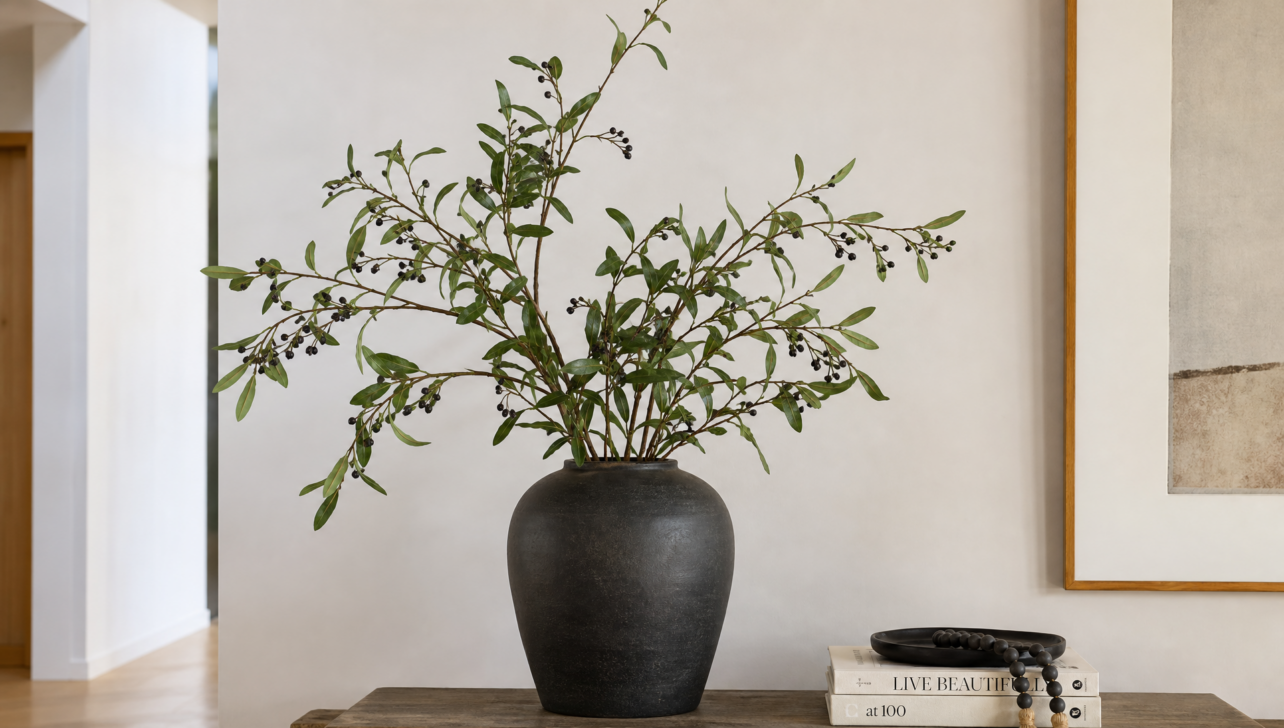
This is where expert stylists reveal the counterintuitive truth: the path to realism runs directly through deliberate imperfection. By trimming stems to varying lengths—not haphazardly, but with intention—you instantly disrupt the artificial uniformity that betrays fake plants. The variation in height creates visual interest while triggering recognition patterns your brain associates with naturally occurring botanical arrangements.
Three Techniques That Transform Fake Into Believable
Vary stem heights. Create stems at different lengths rather than uniform ones. This simple change signals “natural” to your brain immediately.
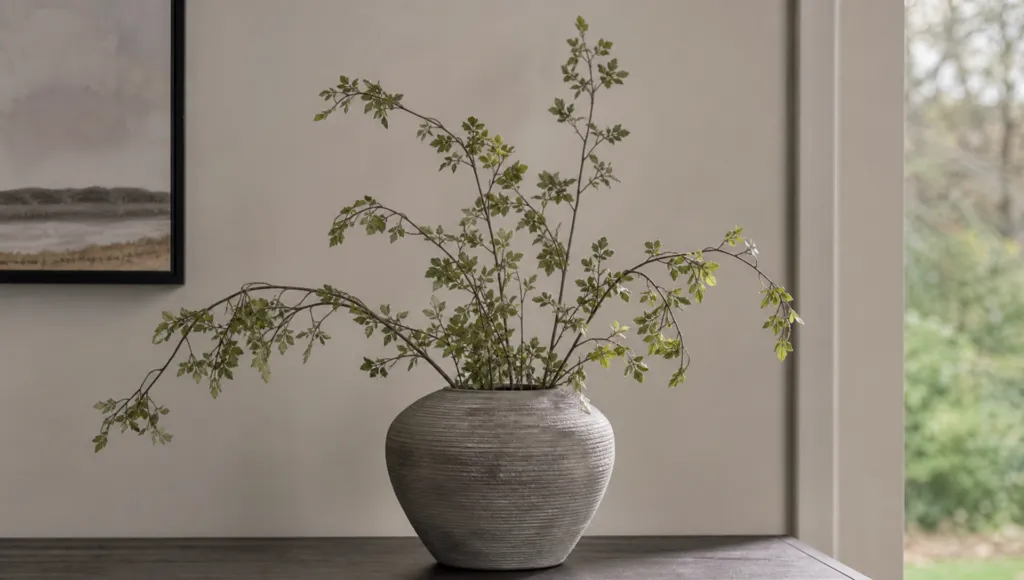
Bend branches downward at different angles. Real plants bend toward light sources or curve under their own weight. When you replicate these subtle directional changes, you remove the visual cues that scream “fake.”
Create deliberate asymmetry. Arrange where one side extends further than the other, completing the transformation. This application of asymmetrical balance creates natural appearance and visual interest that confounds expectations.
This embrace of intentional imperfection reflects a wider design shift across residential spaces. Contemporary interior design increasingly values material tension—the contrast between raw and polished surfaces, unexpected pairings, and deliberate rejection of sterile uniformity. Artificial plants styled with asymmetrical branches and varied heights become design statements rather than mere supplements.
The Invisible Tricks That Make Your Eyes Believe the Lie
High-end designers understand that styling artificial plants is fundamentally a psychological exercise. Your brain doesn’t analyze every detail of what you see; instead, it looks for pattern matches. When it encounters expected elements—water in a vase, soil-like material at the base, stems arranged with natural variation—it processes these as signals of authenticity. Exploit these expectations, and you’ve essentially hijacked the visual evaluation process.
Strategic Layering Techniques
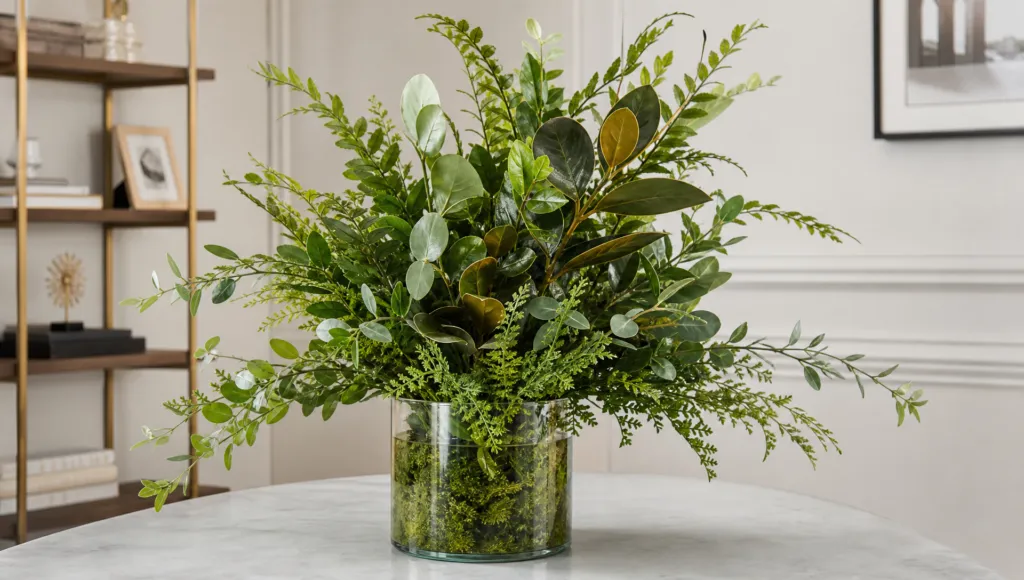
Add water to a transparent vase. This serves dual purposes: it provides visual validation that something living might grow there, and it creates optical distortion through the glass that prevents close scrutiny. Suddenly, viewers see what they expect to see instead of fake components.
Hide the mechanics with fake moss. Strategically placed moss at the base covers the foam, picks, and obvious artificiality of how the plant is mounted.
Create depth in larger arrangements. Professional stylists aren’t simply hanging a single strand of foliage. They vary the prominence of different elements, bend stems to extend at different depths, and use natural color variations within the artificial material itself. These details work because they activate sensory expectations we have for real plants—the way light filters through layered leaves and the organic randomness of natural growth patterns.
How Lighting Changes Everything
Interior styling as a specialized practice encompasses much more than plants alone. Lighting in particular can dramatically affect how botanical elements are perceived. Strategic placement and illumination can enhance features and make spaces more visually pleasing.
These professional practices validate artificial plant styling as a legitimate discipline grounded in established design principles. Just as minimalist plant styling elevates individual specimens on pedestals, faux plant styling achieves believability through intentional restraint and thoughtful placement.
The 2026 Game-Changers: Faux Garlands That Even Critics Can’t Spot
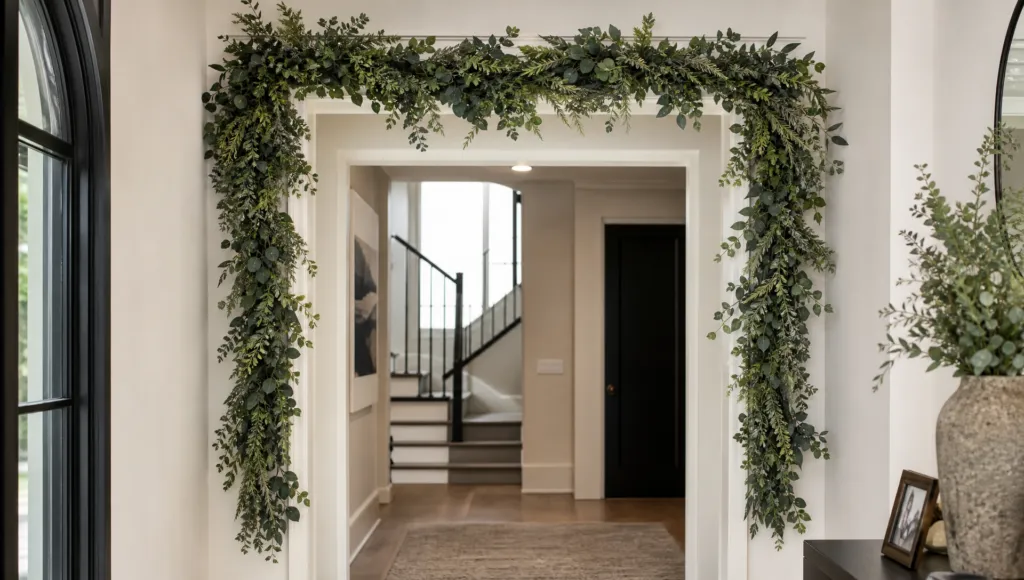
The artificial plant market has experienced genuine innovation in recent years, particularly with garland products designed for high-visibility spaces like entryways and holiday displays. Today’s most convincing options feature engineering choices that directly address the realism problem.
What Modern Garlands Do Differently
Irregular branching patterns replace the uniform repetition that characterized earlier generations. Instead of perfectly identical segments repeating, modern garlands incorporate branches of varying lengths and angles that mirror natural growth patterns.
Layered foliage represents another significant advancement. Rather than a single plane of leaves, quality faux garlands feature multiple layers of material at different depths, creating genuine dimensional complexity. This layering prevents the flat, cardboard-like appearance that traditionally betrayed artificial plants.
Natural color variations within the material itself—subtle shifts from deep green to lighter shades, hints of brown or bronze mixed throughout—replicate the organic color variation you’d see in authentic botanicals.
Beyond Polyester: Advanced Materials
Contemporary manufacturing sometimes incorporates silk flowers, crafted from protein fiber spun by silkworms to produce remarkably lifelike specimens. Specialized artisans also create clay flowers from air-dry polymer clay or cold porcelain, achieving impressive realism. Even hand-blown glass flowers represent the artistic potential of artificial plant manufacturing.
Products Worth Considering
Premium options like Balsam Hill’s outdoor cedar garlands and McGee & Co.’s pre-lit designs demonstrate how far manufacturing has advanced. These aren’t luxury purchases made for brand prestige alone; they represent the current state of artificial plant technology. Afloral’s Norfolk Pine Garland similarly showcases realistic design elements, demonstrating the realism gap has genuinely closed.
Why Fake Plants Are Now a Smart Choice
Convincing fake plants are no longer a compromise on beauty or sophistication—they’re a legitimate design choice offering practical advantages: durability through seasons, consistency in appearance, and freedom from maintenance demands. As interiors increasingly embrace personalized, longevity-focused design over fleeting trends, artificial plants styled with intention represent not just a practical solution but a genuine aesthetic direction.